 English
 中文
中文






Zirconia Parts: Replace the Failure, Not Just the Metal
Related Posts
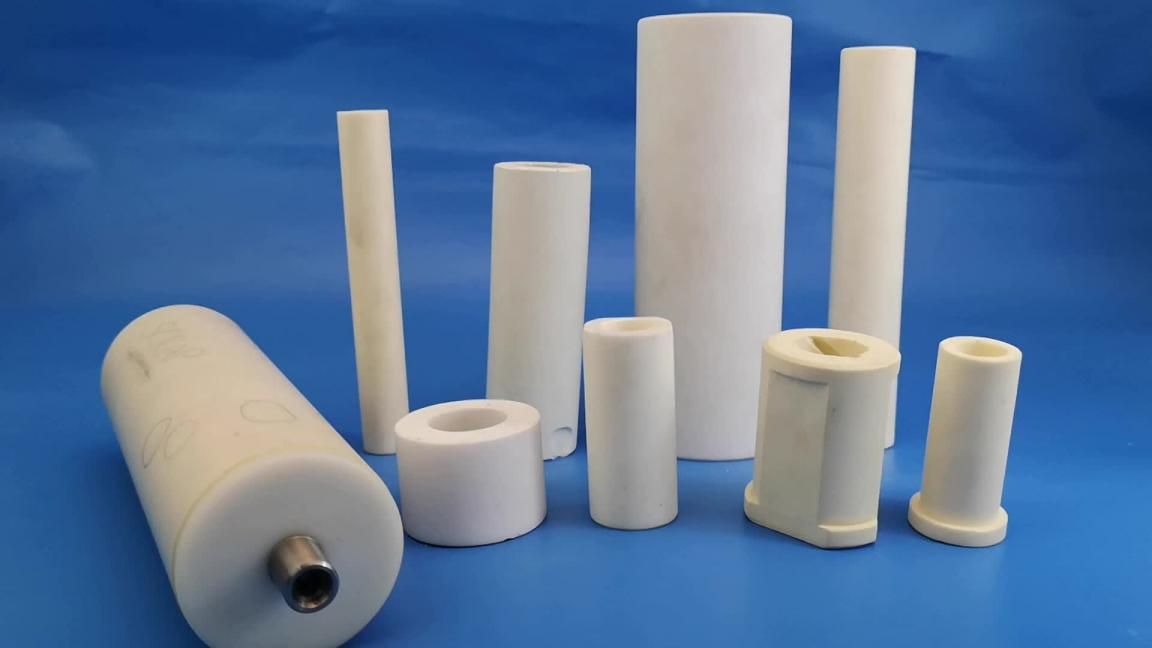
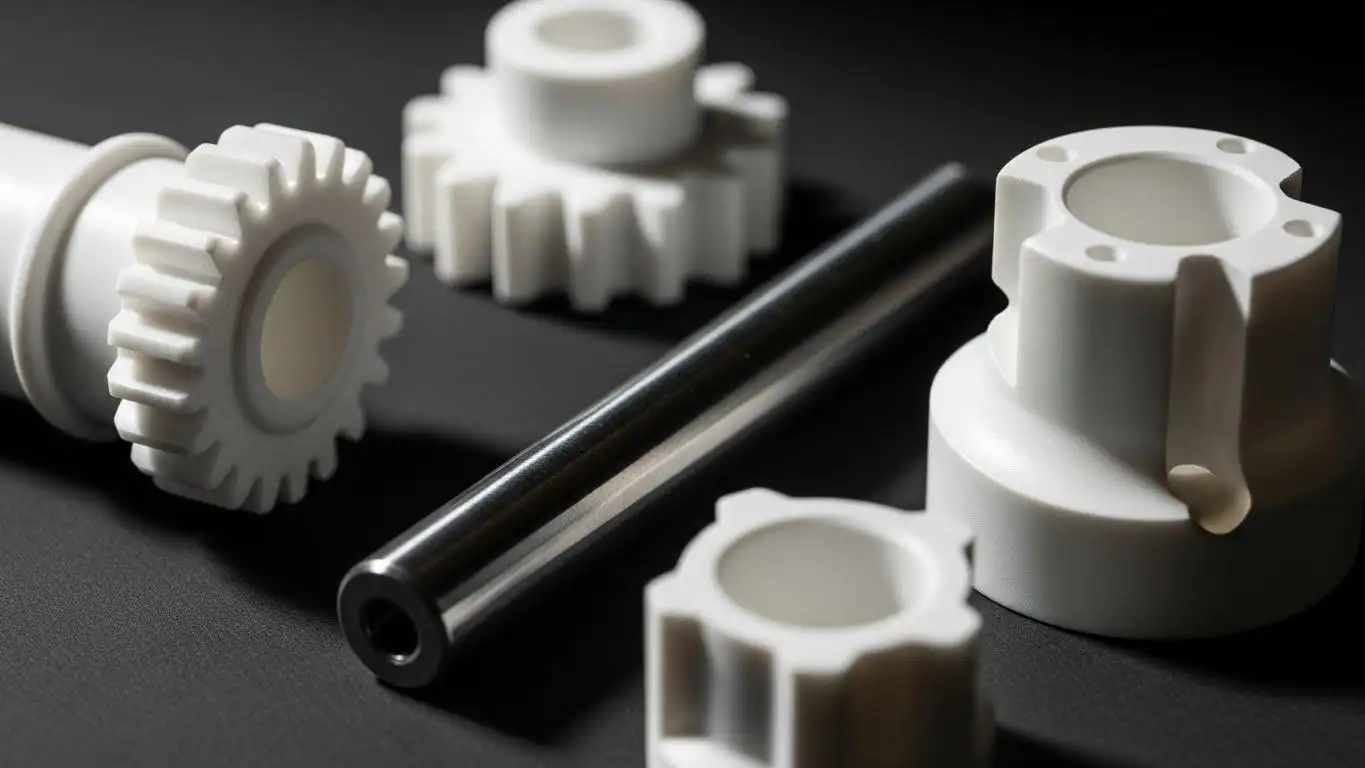
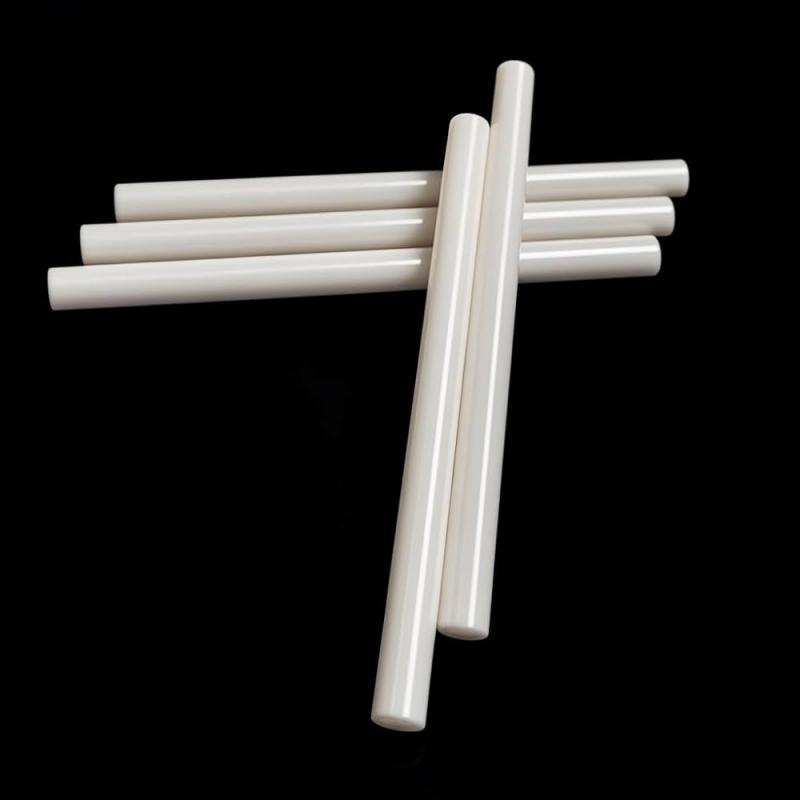
A metal guide will wear out every 3 months. A suggestion is made to make the same part using zirconia.
This might be the way to go, but starting the new drawing by copying the old line by line is seldom the best approach. The steel-machining easy groove might make a weak ceramic area. A press fit that has a metal sleeve tightly attached can cause a zirconia edge to be damaged. The more resistant surface can even pass on wear to the adjacent shaft.
Don't change the material before determining what is the actual failure.
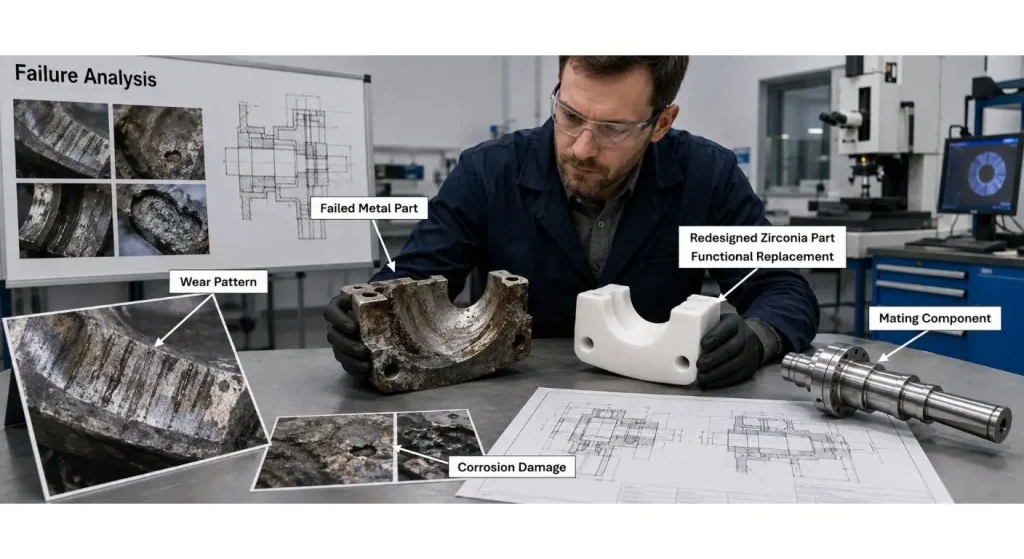
Present Used Part to the Design Review
Information is present in a worn part that is not shown in the original drawing.
Check out a contact band, scoring, corrosion and transferred material and edge impact or dimensional loss. Document the location of the defect and if it is uniform or not.
Check the mating parts also. Zirconia guide cannot fix the shaft run out. Contaminated fluid will not be fixed with a ceramic valve part. A harder roller will last longer, but will cause injury to an improperly selected counterface.
ProuPCERA's custom-made zirconia ceramic parts are available for guides, busings, nozzles, instruments or other drawing applications that require wear resistance, precision or chemical stability. The first question is always useful, however, as it is “why does the current component need to be replaced”?
Use Every Surface a Job to serve as a reference guide.
These locating surfaces, sliding faces, sealing areas, clearance areas and mounting features can all be incorporated into a custom zirconia component. Equal tolerances should not be applied to all of them.
Emphasize the surfaces that control function:
- a hole for a shaft;
- the face making contact with other part;
- the diameter that indicates the part;
- The part that applies force to the clamping;
- Edge which enters the assembly.
Then, determine datums based on the use of the part. A dimension taken from a readily accessible inspection surface may not be as useful as a dimension that is directly associated with the working axis.
Some of ProuPCERA's typical precision controls are roundness, concentricity, straightness, perpendicularity and surface finish, which are listed in its zirconia ceramic structural parts page. Fitting requirements shall only be assigned where they relate to fit, movement or alignment.
| Project Input | What to Confirm | Risk if Missing |
| Existing failure | Wear, corrosion, cracking, deformation or contamination | Material change does not solve the problem |
| Primary function | Guide, seal, support, valve, fixture or insulator | Wrong surfaces receive priority |
| Mating components | Shaft, housing, counterface and fastener | Uncontrolled interface |
| Functional surfaces | Sliding, sealing, locating and clamping areas | Unnecessary or missing precision |
| Geometry | Wall thickness, radii, holes, grooves and transitions | Fragile or costly design |
| Zirconia grade | Strength, toughness and environmental suitability | Unsuitable long-term performance |
| Assembly method | Bonding, pressing, clamping or retention | Chipping or hidden stress |
| Working conditions | Load, movement, temperature and medium | Incorrect material or fit |
| Production route | Forming, sintering, grinding and polishing | Prototype cannot be repeated |
| Inspection | Datums, tolerances, finish and visual criteria | Parts pass inspection but fail in use |
| Packaging | Individual separation and edge protection | Damage after final inspection |
| Field review | Wear pattern, leakage, torque or positioning | Root cause remains unknown |
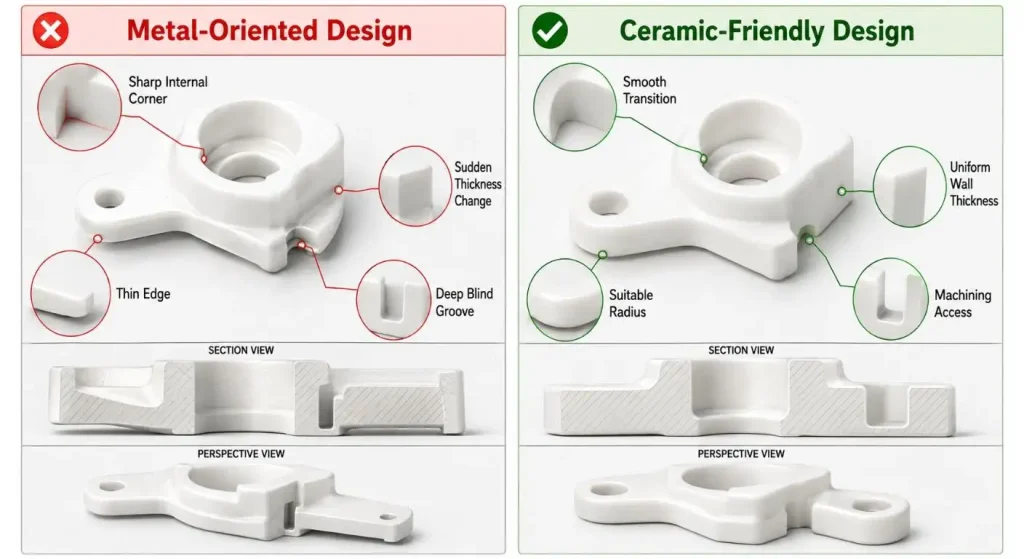
The features were designed for metal, but are now redrawn.
Sharp corners and thin lips inside metal parts, as well as deep threads and sudden thickness changes are often convenient to machine or bend, but are difficult to form in plastic.
Ceramic behaves differently.
Apply radii at stress sensitive transitions. Do not have unnecessarily thin walls next to holes and slots. Check for blind pockets, deep narrow channels and interrupted surfaces before completing the drawing.
A feature can be formed before sintering, formed in a partially processed state, and/or precision-ground after sintering. The same tolerances, cost or geometric freedom are not allowed on these routes.
The more dimensions, the worse drawing is not. It's the one that definitely distinguishes between what matters and what doesn't matter to the geometry to be used to make ceramic parts.
Choose Zirconia for the Dominant Failure Mode
Zirconia is frequently chosen when a part requires wear resistance, increased resistance to crack propagation, electrical insulation, corrosion resistance or non-magnetic properties.
Partly, its toughness is related to transformation toughening. In the common 3Y-TZP materials, stress in the vicinity of a growing crack may cause a local crystal-phase change, which creates compressive stress around the crack tip and thus hinders the propagation of the crack. This increases crack resistance, but does not make zirconia as ductile as steel.
The following should be taken into account in the material selection:
- Contact load and impact;
- slip or turn;
- temperature;
- exposure to fluid or chemical;
- Humidity or exposure to steam for a long period of time;
- electrical requirements;
- required surface finish.
In hot water applications and in steam applications or humid applications where there are high operating conditions for a long time, the zirconia grade and processing route should be specifically reviewed because there is a possibility of hydrothermal aging impacting long-term performance.
It helps design Mating Component at the same time.
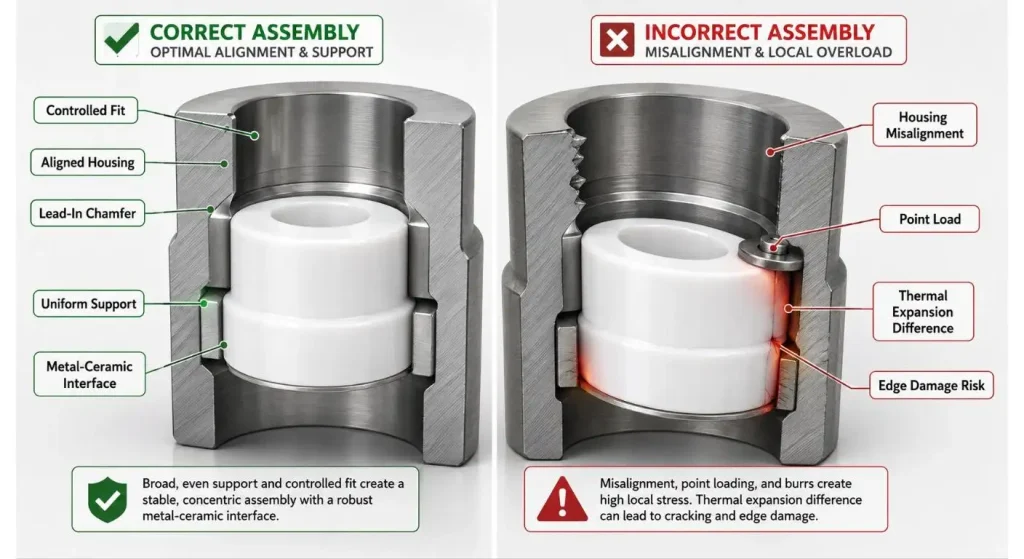
A large number of zirconia failures start at a metal interface.
An overly compact housing bore will result in an uneven radial stress. The small washer can be used to focus the force of the clamp. Even before the machine can even start, the burr may chip the entry edge.
Specify if the part is to be bonded, clamped, retained or press fitted. Include lead-in chamfers, clean contact surfaces and controlled assembly force. If metal is used in combination with ceramic and both are going to change temperature, see how they expand on it.
Never pull misaligned metal parts into position using the ceramic part. There should be alignment prior to tightening the fastener.
Maximize precision where wear will occur.
The action part should be completed on its actual contact pattern.
Smooth motion may be controlled by outer-diameter roundness, straightness, surface finish and end support for a zirconia ceramic roller. The working diameter and its relationship to the datum of the mounting system may be more important for a locating component than its appearance.
Another application for zirconia is to allow repeatable positioning as seen in ProuPCERA precision zirconia ceramic fixture for semiconductor, optical, medical and automated equipment. If so, then the requirement is typically for Datum stability and Contact-face Wear rather than polishing all visible surfaces.
Use a prototype to test the Production Route
A handcrafted sample doesn't necessarily reveal issues that may come up during mass production.
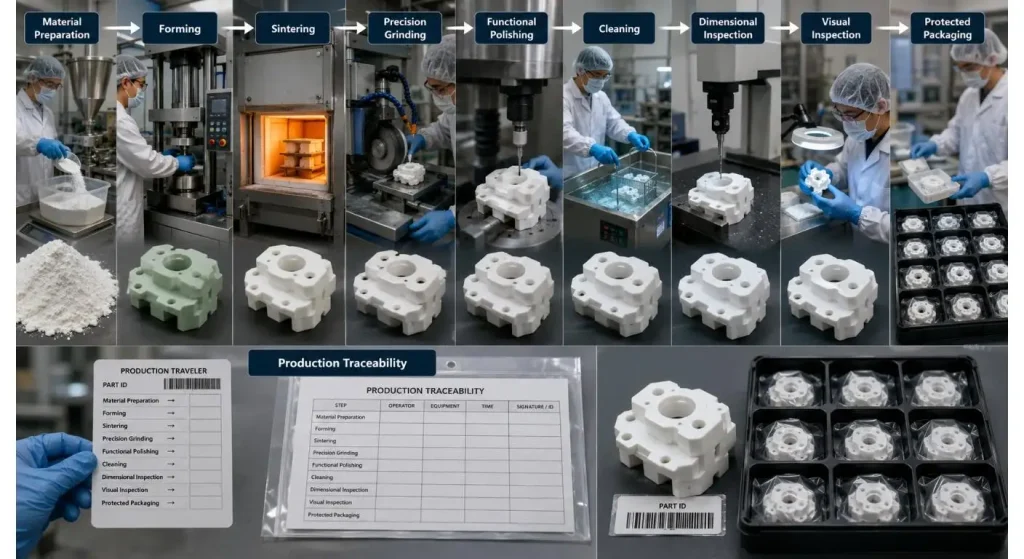
Representative material, forming, sintering, grinding and inspection processes should be utilized in prototype parts. Document all changes to a drawing and verify dimensions that are drawn before and after sintering.
At assembly trials, note:
- insertion force;
- edge contact;
- part orientation;
- clamp condition;
- a torque of movement or running torque;
- leakage or repeatability of positioning;
- damage to the item after it is removed that can be seen.
One sample is not a “controlled production design.”
Inspect for Function—Check the operation of the parts.
Inspection should model part's operation.
Some guide members may need to be made of a diameter, round and straight. Sealing components can be flat, finish and perpendicular. The datum position and repeatability can be a requirement for a fixture.
The following should be specified in visual standards: acceptable chips, acceptable cracks, acceptable pores, acceptable grinding marks and acceptable edge breakout. Don't block or refuse marks that have no impact on function; restrict appearance controls to functional surfaces.
Another aspect of quality control is packaging. When precision faces and edges are required, finished zirconia parts need to be separated to prevent them from coming into contact with each other during transport.
Carefully read the First Production Parts carefully.
More than a “Does it meet the drawing?” should be asked of early production.
Determine if the assembly method is stable, if the inspectors agree on the outcome and if the contact pattern matches with the design assumption. When the parts are returned from the field, check them against the prototype wear record.
You may see a new one side wear mark showing distortion or drift in the housing. If there are multiple edge chips, this could be a sign of handling and not material weakness.
Zirconia shouldn't make it more difficult to spot the original failure mode.
Conclusion
The first step to a successful zirconia part is evidence of failure, not a request for material substitution.
Determine load, movement, contact surface and environment. Then redesign metal oriented features, control such mating surfaces and only give precision to functional surfaces.
When a quotation is required, the drawing, application, the requirement of material, mating parts, load, movement, temperature, medium, assembly method, critical surfaces, quantity and inspection plan should be provided. That information will enable a ceramic manufacturer to create a production part instead of simply replicating an existing shape.
FAQs
Q1. Zirconia parts are used for what?
Their applications include guides, pins, sleeves, rollers, plungers, parts of valves, fixtures, wearing parts and insulating parts.
Q2. Is it possible to directly copy a metal part with zirconia?
In some cases, the sharp corners, press fits, threads and thin sections may require re-design to be suitable for ceramic manufacture and assembly.
Q3. How is it that zirconia is tougher than many ceramics?
There are some types of stabilized zirconias that are toughened against crack propagation through transformation toughening. They still are ceramic materials and can still chip or break.
Q4. Do all surfaces need to have a close tolerance?
No. Tight tolerances should be applied to locating, sealing and other functioning surfaces.
Q5. Which information should be included in a quotation?
Drawings, conditions of application, mating parts, functional surfaces, tolerances, finish, load, environment, quantity and inspection requirements.
Share on Social:


In This Article
- 1 Present Used Part to the Design Review
- 2 Use Every Surface a Job to serve as a reference guide.
- 3 The features were designed for metal, but are now redrawn.
- 4 Choose Zirconia for the Dominant Failure Mode
- 5 It helps design Mating Component at the same time.
- 6 Maximize precision where wear will occur.
- 7 Use a prototype to test the Production Route
- 8 Inspect for Function—Check the operation of the parts.
- 9 Carefully read the First Production Parts carefully.
